Denis MungaiWriter · Data Scientist · Software Developer
February 2026
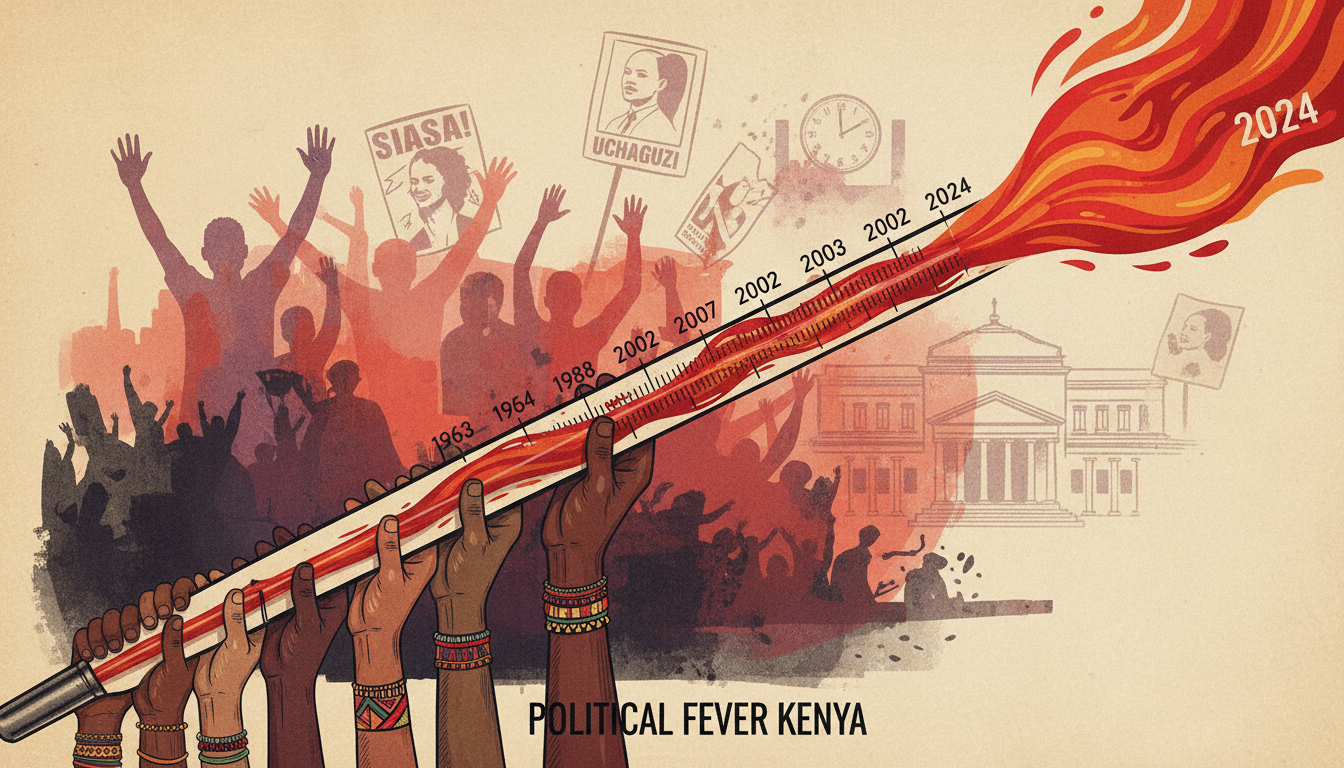
"In Kenya, we do not elect leaders; we merely select the next strain of a fever that has been consuming
us for sixty years, driven by a suicidal optimism that this time, the parasite will mistake itself for
the cure."
In Kenya, we do not elect leaders; we merely select the next strain of a fever that has been
consuming us for sixty years, driven by a suicidal optimism that this time, the parasite will mistake itself
for the cure.
This is not a book about politicians. It is not about Raila Odinga or William Ruto, about Uhuru Kenyatta or
Daniel arap Moi. They are merely characters in a much larger drama—a drama that predates them and will
outlast them. This is a book about us, the Kenyan voter. It is about the psychological condition that keeps
us returning to the ballot box with hope in our hearts, only to be disappointed again and again, yet
returning once more with the same hope, as if the definition of insanity were not doing the same thing
repeatedly and expecting different results.
The 2022 General Election recorded the lowest voter turnout in fifteen years—just 64.77% of registered voters
cast their ballots, down from 79.51% in 2017. This was not merely voter apathy; it was a silent scream, a
withdrawal of consent, a recognition by millions of Kenyans that the ritual had lost its meaning. Yet among
those who voted, the same patterns persisted—the same ethnic calculations, the same hope that this time
would be different, the same suicidal optimism.
Voter Turnout Decline (2002–2022)
Source: IEBC Post Election Evaluation Reports
Figure 1 — Kenya's declining voter turnout reflects a growing crisis of confidence in the electoral
process
What is this fever that grips us every election cycle? Why do we dance in the streets for politicians who
have done nothing to earn our trust? Why do we believe that changing the face at State House will change the
system that has impoverished us for generations?
"The fever is not the politicians; the fever is the system they inhabit—a system
designed not for governance but for extraction, not for service but for patronage."
This book is an attempt to diagnose the fever. It is an uncomfortable examination of our political
psychology, our collective delusions, and the architecture of a system that has learned to survive by
changing its hosts while remaining essentially the same. It is written not to depress but to awaken—not to
destroy hope but to redirect it toward more productive avenues of change.
For if we do not understand the nature of our affliction, we cannot hope to cure it. And cure it we must, for
the fever is killing us—slowly, systematically, and with our own consent.
I
The Anatomy of the Fever
Understanding the Political Euphoria
The Atmosphere of Artificial Euphoria
There is a peculiar atmosphere that descends upon Kenya every five years—a feverish
excitement that seems to infect the entire nation. It begins months before the election, builds to a
crescendo in the final weeks, and then dissipates almost immediately after the results are announced,
leaving behind a hangover of disappointment and resignation.
This artificial euphoria is not accidental. It is manufactured, cultivated, and deployed with surgical
precision by the political class. The rallies, the music, the branded merchandise, the promises of
transformation—all of it is designed to create a collective hallucination in which the voter forgets the
failures of the past and believes, once again, that this time will be different.
The 2022 election campaign was a masterclass in this manufactured euphoria. Despite Kenya facing its worst
economic crisis in decades—with public debt exceeding $80 billion, youth unemployment at 67%, and nearly
half the population living in extreme poverty—the campaign was conducted as if these problems were minor
inconveniences that would be solved by the simple act of changing presidents.
The Economic Reality Behind the Euphoria
68%of every 100 shillings
in tax revenue goes to debt servicing
$80 Billionin public
debt—more than double the state budget
67%youth unemployment rate
in 2024
The disconnect between the campaign rhetoric and the economic reality was staggering. Candidates promised
millions of jobs, universal healthcare, and economic transformation, while the data showed a nation drowning
in debt, with its productive sectors stagnant and its youth despairing. Yet the crowds cheered, the media
amplified the messages, and the voters prepared to make their choices as if these promises had any
connection to reality.
The Transient Hosts
The Kenyan political class functions not as leaders in the traditional sense but as transient hosts for a
system that remains essentially unchanged. From Jomo Kenyatta to Daniel arap Moi, from Mwai Kibaki to Uhuru
Kenyatta, and now to William Ruto—the faces have changed, the ethnic calculations have shifted, but the
fundamental nature of the Kenyan state has remained remarkably consistent.
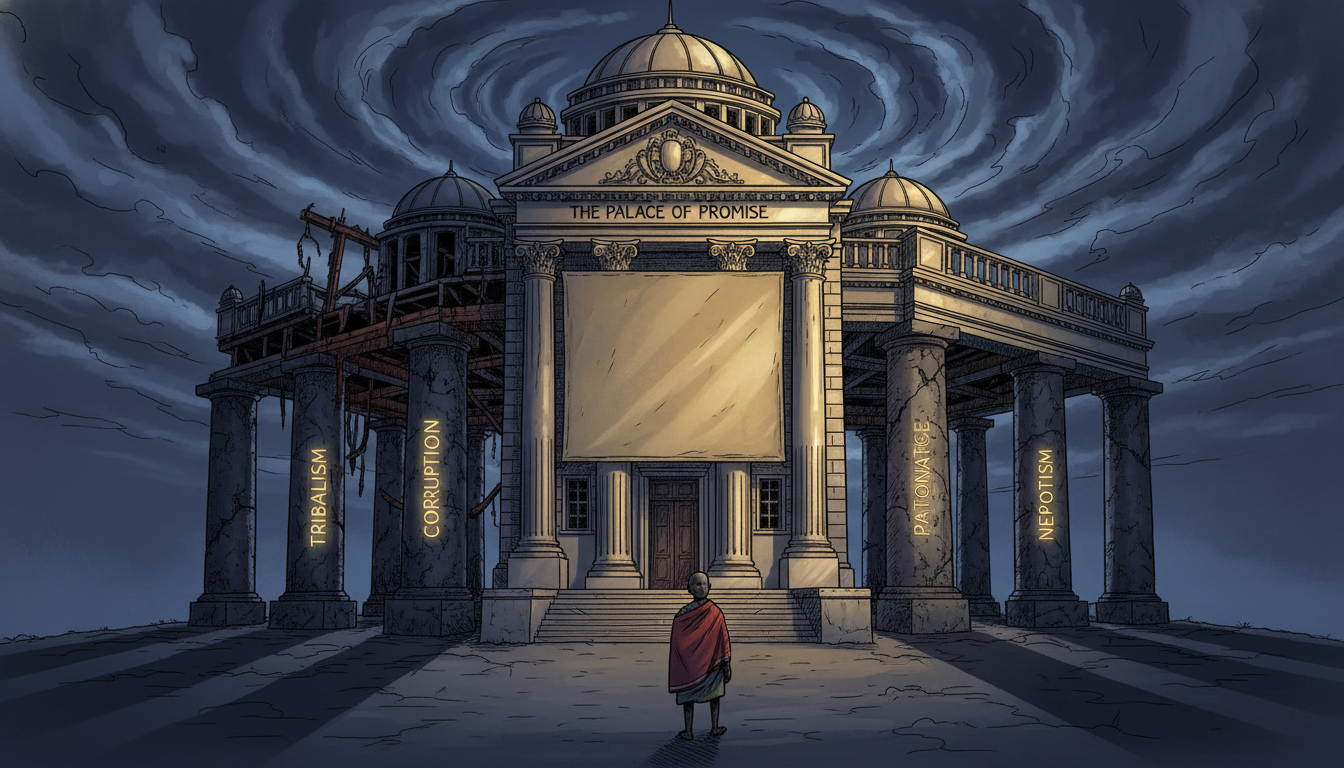
This is the first insight that must be grasped if we are to understand our condition: the politicians are not
the disease; they are merely the symptoms. The disease is the system itself—a system designed during the
colonial era, refined during the Kenyatta and Moi dictatorships, and preserved through the democratic
transition of 2002. It is a system built on extraction rather than production, on patronage rather than
merit, on ethnic mobilization rather than national unity.
Presidential Timeline — 60 Years, 5 Presidents
Source: IEBC Historical Records
Figure 2 — Sixty years of independence: only two ethnic groups have produced presidents
The transient nature of these hosts is essential to the system's survival. Every five or ten years, a new
face emerges with promises of change, giving the population hope that the fundamental problems will finally
be addressed. When these promises are inevitably broken, the population's disappointment is directed at the
individual rather than the system, and the cycle begins anew with the next host.
The Operating System of 1963
The most profound illusion in Kenyan politics is the belief that we have undergone fundamental political
change since independence. We have not. What we have experienced is a series of user interface updates—the
buttons have moved, the colors have changed, but the underlying operating system remains the same one
installed in 1963.
This operating system has several core features that have persisted across all administrations:
Centralized executive power: The President controls appointments to all key
institutions, from the judiciary to the electoral commission to the anti-corruption agencies. This
ensures that no genuine check on executive power exists.
Ethnic arithmetic: Political competition is structured around ethnic mobilization
rather than policy debate. The "tyranny of numbers" determines electoral outcomes, making policy
irrelevant.
Patronage networks: Access to state resources is determined by political loyalty rather
than need or merit. The state functions as a spoils system to be distributed among supporters.
Impunity: Those connected to power face no consequences for corruption or abuse of
office. The law is enforced selectively, primarily against the powerless and the opposition.
"The noise of the rallies is a collective hallucination designed to hide the fact that
the operating system hasn't been updated since 1963; only the UI changes."
The 2010 Constitution was supposed to change this. It introduced devolution, created independent
institutions, and promised a new era of governance. And to some extent, it did—the counties have provided
new avenues for service delivery, and some institutions have shown independence. But the fundamental
architecture of power remains unchanged. The President still controls the purse strings, still makes the key
appointments, and still determines who prospers and who suffers.
Until we recognize that the problem is not the hosts but the operating system they inhabit, we will continue
to cycle through the same pattern of hope and disappointment, election after election, generation after
generation.
II
The Psychological Autopsy
Understanding Suicidal Optimism
Defining Suicidal Optimism
Suicidal optimism is the recurring belief that a new predator will somehow protect the prey.
It is the conviction, against all evidence, that the politician who has spent decades in the same system
that has failed us will somehow be the one to transform it. It is the hope that the wolf, if given enough
time in the sheepfold, will become a shepherd.
This psychological condition is not unique to Kenya, but it has taken on a particularly virulent form here.
The reasons are historical and structural. We are a young nation that achieved independence with great hope
and optimism. The first decades of independence saw genuine economic growth and social transformation. The
disappointment of the Moi years was followed by the promise of multiparty democracy, and the disappointment
of the multiparty era was followed by the promise of the 2002 "Kibaki Tosha" moment, and the disappointment
of the Kibaki years was followed by the promise of the 2010 Constitution.
Each cycle of hope and disappointment has left its psychological scar, but it has not extinguished the hope
itself. If anything, the hope has become more desperate, more willing to believe in miracles, more
susceptible to the charms of any politician who promises transformation.
Why Kenyans Don't Vote — Root Causes of Apathy
Source: URAIA Voter Apathy Study 2022
Figure 3 — The root causes of voter apathy reveal deep distrust in the electoral process
The data from the 2022 elections reveals the extent of this crisis. According to URAIA's voter apathy study,
the main reasons Kenyans didn't vote were: lack of trust in the electoral process (33%), disinterest in
elections (32%), and the belief that elections would be rigged (20%). These are not the responses of a
healthy democracy; they are the responses of a population that has lost faith in the fundamental mechanisms
of representation.
The Stoic Lens: Loss of Agency
The ancient Stoics made a distinction between what is within our control and what is not. They taught that
wisdom lies in focusing our energy on the former while accepting the latter with equanimity. The Kenyan
voter has lost this distinction. We focus obsessively on the external—the candidate's face, their promises,
their ethnic identity—while ignoring the internal—the systemic rot we consent to, the patronage networks we
participate in, the corruption we tolerate.
This loss of agency is not accidental. It is cultivated by a political class that benefits from our
passivity. We are encouraged to see politics as something that happens to us rather than something we do. We
are spectators at our own governance, cheering or booing from the sidelines while the real decisions are
made in boardrooms and private clubs.
"We focus on the 'external' (the candidate's face) while ignoring the 'internal' (the
systemic rot we consent to)."
The 2024 Gen Z protests against the Finance Bill represented a partial recovery of this agency. For the first
time in decades, young Kenyans took to the streets not in support of a politician but in opposition to a
policy. They organized online, bypassing the traditional political structures, and forced the government to
withdraw the bill. It was a glimpse of what citizen power could look like when it is not mediated through
the ballot box.
But the protests also revealed the limits of this agency. The government responded with violence—at least 39
protesters were killed, 361 injured, and 627 arrested. The message was clear: citizen agency will be
tolerated only within narrow bounds, and those who step outside those bounds will be punished.
The Last Samurai Theme
There is something noble in the Kenyan voter's persistence, something almost tragic in our willingness to
keep believing despite all evidence. It is the nobility of the last samurai, fighting a battle he knows he
cannot win because the alternative—surrender—is unthinkable.
But this nobility is misplaced. We are not fighting a battle; we are participating in a ritual designed to
fail us. We are not warriors; we are extras in a drama written and directed by others. Our participation in
elections does not challenge the system; it legitimizes it. Our votes are not weapons of change; they are
tokens of consent.
Youth Disengagement — The Silent Protest
Source: IEBC Voter Registration Data
Figure 4 — Youth voter registration decline signals a generation's withdrawal from formal politics
The youth understand this better than their elders. The decline in youth voter registration—from 45% of
registered voters in 2017 to 39.84% in 2022—is not apathy; it is a rational response to a system that has
failed them. Why participate in a ritual that has no connection to your lived reality? Why vote when you are
unemployed, when your education has not opened doors, when your future seems to consist of endless hustling
for survival?
Their withdrawal is a form of protest, a refusal to legitimize a system that offers them nothing. And their
return to the streets in 2024 was a declaration that they would find other ways to make their voices
heard—ways that did not depend on the ballot box or the political class.
III
The Architecture of Deceit
Systemic Logic of Kenyan Politics
Features, Not Bugs
To understand the Kenyan political system, one must abandon the assumption that its
dysfunctions are accidental. Corruption is not a bug to be fixed; it is a feature designed into the system.
Tribal mobilization is not an unfortunate legacy of the past; it is a deliberate strategy of control. The
failure of development is not a consequence of poor planning; it is the inevitable result of a system
designed for extraction rather than production.
This is a difficult truth to accept. We prefer to believe that our leaders are well-intentioned but
incompetent, that corruption is the work of a few bad apples, that with the right policies and the right
people, the system can be made to work. But this belief is itself a form of suicidal optimism—a refusal to
see the system for what it is.
Consider corruption. Kenya ranks 130 out of 180 countries on Transparency International's Corruption
Perception Index, with a score of just 30 out of 100. This is not an accident or a failure of enforcement.
It is the result of a system in which those with political connections are above the law, in which
anti-corruption agencies are controlled by the very people they are supposed to investigate, and in which
the judiciary can be bought or intimidated.
Corruption Perception Index — Kenya vs. Region
Source: Transparency International 2024
Figure 5 — Kenya's Corruption Perception Index shows persistent high levels of corruption
The figures are staggering. According to Oxfam Kenya, the richest 1% of Kenyans control 78% of the country's
total financial wealth. The 125 richest Kenyans possess more wealth than 42.6 million citizens combined.
This concentration of wealth is not an unfortunate side effect of economic growth; it is the direct result
of a political system that channels public resources to private hands through corruption, patronage, and
cronyism.
The Great Economic Divide
78%of Kenya's financial
wealth controlled by the richest 1%
125richest Kenyans own more
than 42.6 million citizens combined
214×a CEO in top 10
companies earns 214 times more than a teacher
The Cycle of Consumption
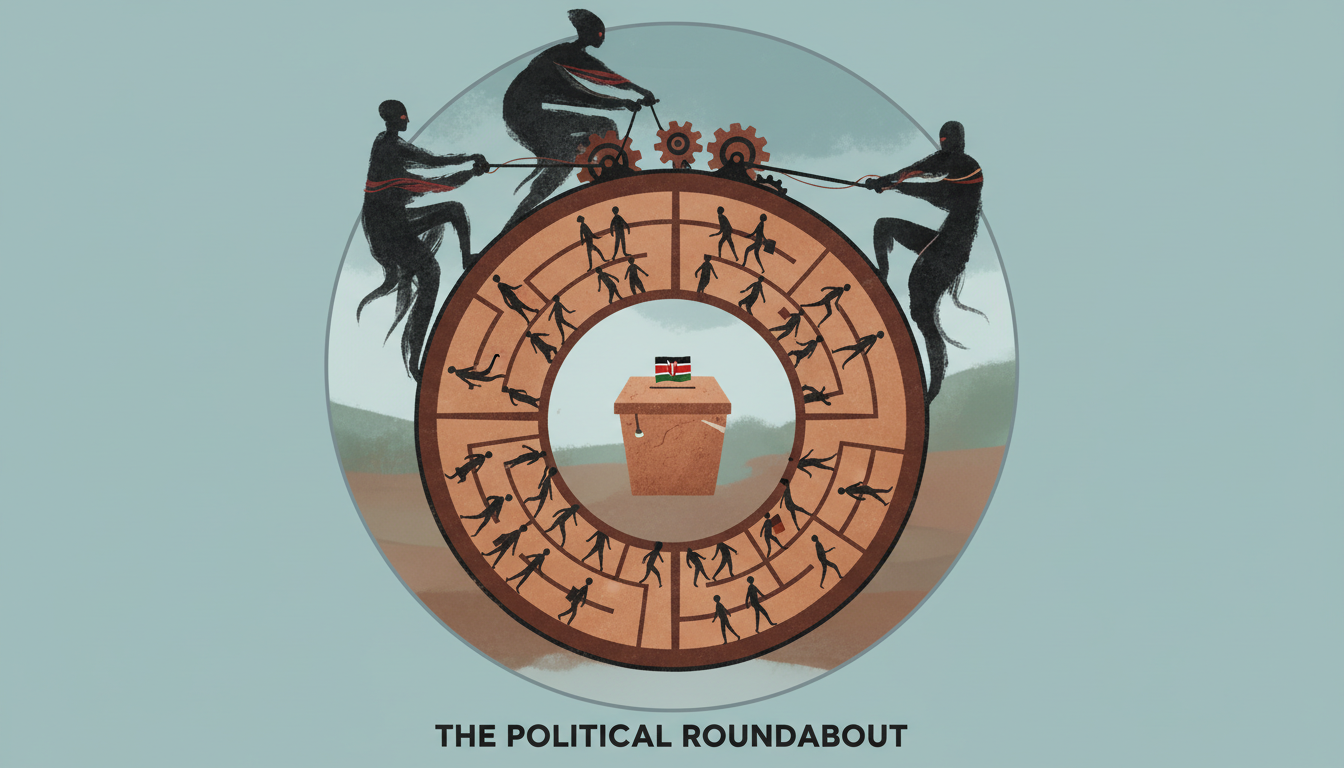
The Kenyan political system functions as a cycle of consumption. Every five years, the population is fed a
new narrative of hope and transformation. They vote, hoping that this time will be different. The new
government takes office, appoints its loyalists to key positions, and begins the process of extracting
resources for itself and its supporters. Promises are broken, scandals emerge, and disappointment sets in.
By the next election, the population is ready for a new narrative, a new face, a new hope—and the cycle
begins again.
This cycle serves the interests of the political class perfectly. It keeps the population engaged enough to
legitimize the system through voting, but not engaged enough to demand fundamental change.
Wealth Distribution in Kenya (2024)
Source: Oxfam Kenya Inequality Report 2025
Figure 6 — Extreme wealth concentration in Kenya undermines social cohesion
The Dog Analogy
There is an analogy that captures the essence of this system. Imagine a dog that is trained to expect a treat
every time it performs a trick. The dog learns the trick, performs it enthusiastically, and receives its
reward. Over time, the dog becomes so conditioned to the ritual that it continues to perform even when the
treats become smaller and less frequent.
The Kenyan voter is that dog. We have been trained to expect transformation every five years, to perform the
trick of voting in exchange for the promise of development. We perform enthusiastically, dancing at rallies
and cheering at promises, even though the treats have become smaller and less frequent with each cycle.
"The system requires a fresh 'new leader' every few years to keep the populace pacified
while the devouring continues unabated."
The system requires this fresh "new leader" every few years to keep the populace pacified while the devouring
continues unabated. The new leader provides the illusion of change, the hope of transformation, the
narrative that allows the system to survive another cycle.
The 2022 election was a variation on this theme. William Ruto positioned himself as the "hustler" candidate,
the outsider who would challenge the dynasties and transform the system. He promised a "bottom-up" economic
model that would lift the poor out of poverty. And yet, within months of taking office, his government was
proposing tax increases on basic commodities, his officials were embroiled in corruption scandals, and the
economic situation of ordinary Kenyans was deteriorating.
The system had changed its host, but the fever remained.
IV
Breaking the Fever
Pathways to Genuine Change
The Hard Truth
The fever will not break by changing the host. This is the hard truth that must be accepted
if we are to move forward. No politician, however well-intentioned, can transform a system that is designed
to resist transformation. No election, however free and fair, can produce outcomes that the system is not
designed to deliver.
This truth is difficult to accept because it challenges our most deeply held beliefs about democracy. We have
been taught that voting is the primary mechanism of change, that the ballot box is where citizens exercise
their power. And in a well-functioning democracy, these things are true. But Kenya is not a well-functioning
democracy. It is a competitive authoritarian system in which elections serve to legitimize rather than
challenge the existing order.
The 2024 Finance Bill protests offered a glimpse of an alternative. When young Kenyans took to the streets,
they bypassed the electoral system entirely. They did not wait for the next election to express their
grievances; they expressed them directly, through collective action. And they achieved something that
decades of voting had not achieved—they forced the government to withdraw a policy.
Kenya's Debt Crisis — Revenue vs. Debt Servicing
Source: World Bank & Transparency International 2025
Figure 7 — Kenya's debt crisis crowds out spending on essential public services
Elections still matter—they determine who holds power, who makes appointments, who controls the purse
strings. But they are not sufficient. They are one tool among many, and in the Kenyan context, they are not
the most effective tool for achieving fundamental change.
The Call to Mastery
The Stoics taught that the path to freedom lies in mastering oneself—one's desires, one's fears, one's
reactions to external events. This is the challenge facing the Kenyan voter: to master our suicidal
optimism, to see the system clearly for what it is, and to channel our energy toward strategies that have a
genuine chance of producing change.
Clarity of vision: We must see the system for what it is—not a broken democracy that
can be fixed with better leaders, but a functioning extraction machine that serves the interests of a
small elite.
Strategic patience: Fundamental change does not happen in five-year electoral cycles.
It requires sustained organizing, institution-building, and culture-changing work over decades.
Diversified tactics: Voting is one tactic among many. We must also engage in protest,
in civil society organizing, in media activism, in economic self-organization.
Collective solidarity: The system thrives on our division. We must build solidarity
across these divisions.
"True 'change' requires a 'refactoring' of the citizen's mind—a move from optimism to
clarity."
The Refactoring of the Citizen's Mind
The most profound change must happen within ourselves. We must refactor our minds—restructure our
assumptions, our beliefs, our automatic responses to political stimuli. We must move from optimism to
clarity, from hope to strategy, from passive spectatorship to active citizenship.
From personality to structure: We must stop evaluating politicians based on their
personalities, their charisma, or their promises, and start evaluating them based on the structural
constraints they face and the interests they represent.
From events to processes: We must stop focusing on electoral events as the primary sites of
political change and start focusing on the ongoing processes of organizing, advocacy, and
institution-building.
From consumption to production: We must stop consuming politics as spectators and start
producing it as active participants—organizing in our communities, holding leaders accountable, building
alternative institutions.
From ethnic to civic identity: We must stop seeing ourselves primarily as Kikuyu, Luo,
Kalenjin, or Luhya, and start seeing ourselves primarily as Kenyan citizens with shared interests and common
destiny.
These shifts are difficult. They go against decades of conditioning, against the habits of a lifetime. But
they are necessary if we are to break the fever and build a genuinely democratic Kenya.
E
Epilogue
The Pen and the Knife
The Final Image
Imagine a voter standing at the ballot box. In their hand is a pen, the instrument of
democratic participation, the symbol of citizen power. But as they look more closely, they realize that the
pen is actually a knife—a knife they have been using, election after election, to cut their own throat.
This is the final image I want to leave with you. Not to depress you, not to make you despair, but to wake
you up. The ballot box is not the only site of political action, and the pen is not the only instrument of
change. We have other tools at our disposal—our voices, our feet, our organizing power, our economic
leverage, our collective solidarity.
The 2024 Gen Z protests showed us what is possible when citizens stop waiting for the next election and start
taking action in the present. They showed us that the fever can break, if we are willing to take the
medicine.
"The arc of the moral universe is long, but it bends toward justice—if we bend it."—
Adapted from Martin Luther King Jr.
The task before us is not easy. The system has survived for sixty years because it is resilient. But there is
always an alternative. The alternative begins with clarity. It continues with organization. And it
culminates in action—the sustained, strategic pressure that can force fundamental change.
The hosts will continue to change. New faces will emerge with new promises. The fever will try to reassert
itself. But we will know better. We will see the system clearly, we will organize strategically, and we will
act collectively. And slowly, painfully, but inevitably, we will bend the arc of our nation's history toward
justice.
* * *
The voter at the ballot box looks at the pen in their hand. They see it for what it is—a knife they have been
using against themselves. And for the first time, they decide to put it down. They turn away from the ballot
box and walk toward their community, their neighbors, their fellow citizens. They begin to organize, to
mobilize, to build the collective power that can challenge the system itself.
This is where the story begins. Not at the ballot box, but in the streets, in the communities, in the
countless acts of solidarity and resistance that build the foundation of genuine democracy. The fever is
breaking. The awakening has begun. The future is ours to shape.
Data Appendix: The Numbers Don't Lie
Table 1: Voter Turnout Trends (2002-2022)
Year
Registered Voters
Voter Turnout
Change
2002
10,451,150
56.0%
—
2007
14,296,180
69.1%
+13.1%
2013
14,352,533
85.9%
+16.8%
2017
19,611,423
79.5%
-6.4%
2022
22,120,458
64.8%
-14.7%
Table 2: 2022 Presidential Election Results
Candidate
Votes
Percentage
William Ruto
7,176,141
50.49%
Raila Odinga
6,942,930
48.85%
George Wajackoyah
61,969
0.44%
David Mwaure
31,987
0.23%
Table 3: Economic Indicators (2024)
Indicator
Value
Source
Public Debt
$80+ billion
World Bank
Debt Servicing (% of revenue)
68%
Oxfam Kenya
Youth Unemployment
67%
Transparency International
Extreme Poverty Rate
46%
World Bank
Wealth Controlled by Richest 1%
78%
Oxfam Kenya
Corruption Perception Index
30/100 (Rank 130/180)
Transparency International
Table 4: Causes of Voter Apathy (2022)
Reason
Percentage
Lack of trust in electoral process
33%
Disinterest in elections
32%
Belief that elections are rigged
20%
Belief preferred candidate won't win
15%
Lack of money for transport
14%
Lack of knowledge about process
12%
Source: URAIA Voter Apathy Study
2022
References
African Union & COMESA. (2022). Election Observation Mission Report: Kenya General Elections
2022.
Commission of Inquiry into Post-Election Violence. (2008). Report of the Commission of Inquiry into
Post-Election Violence.
GeoPoll. (2022). Kenya Elections 2022: A Survey Report.
IEBC. (2022). Post Election Evaluation Report.
Kenya National Bureau of Statistics. (2024). Economic Survey 2024.
Kofi Annan Foundation. (2022). Kenya Post-Election Roundtable 2022 Review.
Oduor, R. M. J. The History of Ethnicised Politics in Kenya. African Journal of Political
Science.
Oxfam Kenya. (2025). Kenya's Inequality Crisis: The Great Economic Divide.
Stats Kenya. (2025). Kenya General Elections Presidential Results and Voter Turnout 2022.
Transparency International. (2024). Corruption Perceptions Index 2024.
Transparency International. (2025). Kenya's Debt Crisis: Misaligned Financing and Corruption.
URAIA Trust. (2022). Voter Apathy Study 2022: Final Report.
USIP. (2013). Elections and Violent Conflict in Kenya.
WFD & NIMD. (2021). The Cost of Politics in Kenya.
World Bank. (2025). Kenya Economic Update.
About the Author
Denis Mungai is a writer, data scientist, and
software developer. This book is a work of political commentary and analysis, synthesizing research from
multiple sources. The views expressed are intended to stimulate critical thinking about Kenya's
political system and the possibilities for genuine democratic transformation.
The title and conceptual framework were inspired by a
conversation between the author and Google's Gemini AI, which helped articulate the central metaphor of
the "fever" that persists despite changing political hosts.